Sunday, 12 July 2015

Four Squares Estate: Guerilla gardening

Below my flat are two large brick raised beds for flowers.  They have a couple of sad, diseased looking rose bushes in them and a lot of weeds.  It did not take me long to get the itch to rescue them.  But where to find flowers in Bermondsey?  In Birmingham there are plant shops on just about every street plus a garden centre just behind where I live  .London is a vast urban desert with no plants.  I try Tesco, Canada Water, Jamaica Road.  Wherever I go in London I look for shops selling cheap plants.  Or any plants, with roots.  Or bulbs.    The only place I see plants in profusion is Chelsea Flower Show and they are not for sale.
  
Only in The Blue, at the small, struggling local market, can I find plug plants, sold from a barrow.  They are amazed when I buy up, at a very good price, all the plug geraniums I can carry in two large plastic bags.
I plant them out and go back for more.
Then I collect all the seed from my garden and throw it all over the beds.
Result, a fine crop of opium poppies, a few foxgloves, nasturtiums and a lot of cheerful mixed geraniums.


In the autumn I have the job of removing all the dead plants.  I plant tulip and narcissi bulbs and, in February,  I bring some snowdrops.  They all come up.


This year the Four Squares Estate renovations are all happening.  The council blocks are all covered in scaffolding and green netting.  I thought it would be dark under all the nets but it is really not too bad, and it is very exciting to see wonderful shiny new UPVC windows going in.  Suddenly the run down Four Squares is looking almost respectable.


Because of the building work I did nothing to the guerilla garden this spring.  But nature did its work for me.  A fine crop of foxgloves has taken over.


e-mail: childhoodblog@gmail.com

Tigers in Southwark Park


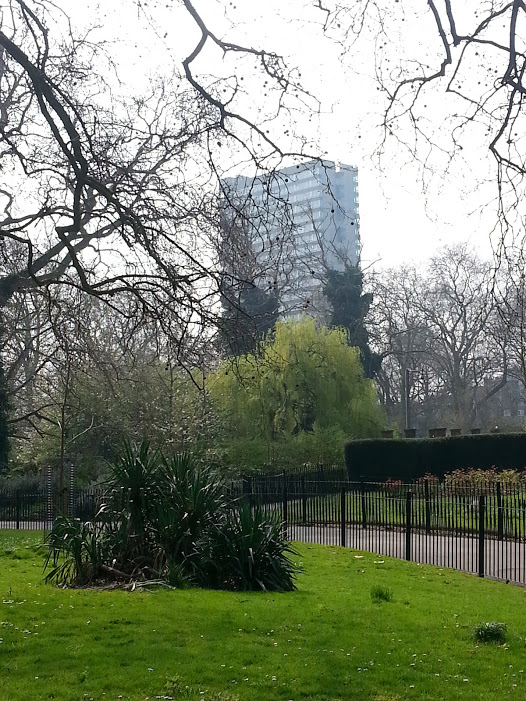
Bermondsey and Rotherhithe have a beautiful city park.  Southwark Park is right on the boundary between the old boroughs and there used to be a lot of in-fighting between them over its management.  Now they are both part of Southwark and the park is listed Grade II.  With Kings Stairs Gardens across Jamaica Road this green lung goes right down to the river.   Surrounded by council flats it is still like being out in the countryside.


There is quite a lot of wildlife


T


There is a bandstand from Queen Victoria's Great Exhibition, installed in 1884 and a drinking fountain..


There are two wonderful caryatids holding up nothing in the shrubbery. These come from Rotherhithe Old Town Hall, 1897, which was bombed in World War II.  In 1974 these were moved to the Heygate Estate, but now that huge council block has been demolished they are in the park


By 1885 a boating lake had been added, and there are still paddle boats for hire.

Near the lake is the oasis of Ada Salter's Garden.  Ada Salter was married to Dr. Alfred Salter.  They both worked tirelessly to improve the slums of Bermondsey, fighting disease and trying to improve the borough's housing and living spaces.  They planted the thousands of trees we still enjoy and created gren space wherever they could.  Ada became the first woman Labour Mayor in 1922, Alfred Salter became a Labour MP and both were Labour councillors.  The garden was created in memory of Ada Salter in 1934.

There are two art galleries showing pretty good exhibitions, a nice cafe, a good playground, a running track, lots of space for ball games and running around and a bowls club.  The park is used a lot by the locals especially mums with small children.

Across Jamaica Road on the Thames is Kings Stairs Gardens.  Edward III built a manor house here in the 14th century and it was used until Tudor times.  Later there was a working commercial pottery on the site.  The remains of the manor house are still there in the garden.   Here is an artist's idea of what the manor looked like.


e-mail:  childhoodblog@gmail.com

Thursday, 29 November 2012

Gormley at White Cube

Doing my civic duty I picked up a newspaper from the pavement.  It was the  Evening Standard, full of interesting stuff including Antony Gormley's new show, Model, at White Cube.  My local White Cube in Bermondsey, which would fit in well with my plan to explore Bermondsey Street.

Carrying Southwark Council booklet The Story of Bermondsey, I walked down Jamaica Road, pioneering a new route to Bermondsey Street.  Down Tanner Street, in the bit the bus can't penetrate,  I found a massive warehouse full of antique furniture, very nice.  On to Tower Bridge Road and the squat little church of St. Mary Magdalen with its astonishingly low steeple, hardly a steeple at all.  But the church is the oldest building in Bermondsey, built in 1291 right next to Bermondsey Abbey.  The Abbey stood roughly between Grange Walk, where there are still remains of the Gatehouse, and Bermondsey Square where the Friday antiquyes market is held.  The small building by the church was the parish watch house, where any local malefactors were detained by the night watchmen.


Bermondsey Street runs across Tower Bridge Road here.  It is probably the oldest street in Bermondsey, narrow with warehouses on either side and cobbled alleys leading into old yards. It is the place I fell in love with on my very first visit to Bermondsey, walking across Tower Bridge to Zandra Rhodes Museum of Fashion and Textile.

Bermondsey | White Cube

The gleaming modernity of White Cube stands back behind a courtyard.  In the Model Room Antony Gormley was talking about his maquets, fascinating essays in translating the human form into cubes and playing around with extending them.  Perspex and wire models and drawings show the internal working structures.  In the white rooms the nearly black metal models are austere and beautiful; standing, lying, crouching.  Finally, stretching the length of one room, lies an interactive cubed form, an exploration of inner and outer space.  Enter the tunnel at the toe, adjusting to the dark, and feeling cautiously, a hand out and up to feel the wall and ceiling.  Explore the marks on the surface.  Crawl through the dark, dark tunnel towards faint light.  See the square of light ceiling where the roof opens up, fortuitously incorporating the square light fittings of the gallery.  Sitting on a shelf and looking around I saw shades of grey squares superimposed one on another, with one triangle of light.  Then there was a very, very dark space, pitch velvet black but with a faint reflective gleam from some far wall.  Walking slowly forward, hand outstretched and raised, I suddenly hit a barrier, the reflection was deceptive.  This is the head.  Then back to where I found a shelf and a space darker than the dark around and crawled to the back.  I observed invisibly and sat and listened to the boom, boom of people's feet on the metal, drummed with my hand and someone drummed back. 
I wondered when I saw the perspex maquets why Gormley made the final model opaque but now I understood.  Transparent would be another story.

whitecube.com/

  Model

Tuesday, 20 November 2012

Eel Pie and Mash


The first time I tried eel was down The Cut, by the Young Vic.  I had gone to see Trevor Nunn's  
Timon of Athens, so that is a long time ago.  I had, I think, jellied eels, in a white-tiled eel pie shop.  I went to look for it last week but it is not there now.

 
My next eel was at Lou Farrow's Snack Bar and Take Away; Traditional Pie and Mash,  down the Blue, off Blue Anchor Lane, just past the railway bridge, in Bermondsey.  It is a cafe.  I went in and asked for eel pie and mash and the man at the counter said something I didn't understand.  He said it again, I still didn't understand.  He asked again so I said 'yes'.  He gave me a pie, some mashed potato a bowl of green liquid with chunks of something interesting in it, and another bowl of more green liquid.  The eels were in the first bowl.  They were, well, interesting.  The green liquid was like a thick green soup.  It turned out he was asking me if I wanted extra 'liquor'; the green soup.   Till last week I thought it was pea soup but it isn't.

 Last week I went to Manze's Noted Eel & Pie House which is on Tower Bridge Road.  I got beef pie, very nice, stewed eels, soft and succulent, on the same plate, with mashed potato, and, separately, more of the mysterious green soup stuff.  This time as I understood what the woman serving was saying, I asked her what was in it, and it turned out to be parsley.    It was pretty good.  There is another Manze Eel Pie House in Peckham which I will try next time I am up that way.  The shop was full of locals, eating at long wooden tables, with a few Japanese tourists, probably looking for authentic London grub, like me.
The original shop was established in 1902, there is an internet site, and they say they will deliver throughout the UK, to other pie shops.


After that I walked back to the market at The Blue and found the fishmonger, who was selling jellied eels.  They were in salt jelly, which was nice, but the eels were a bit rubbery.  I need to experiment further with these.  The fishmonger told me that these days the eels don't come from the Thames but all the way from Ireland; Mick's Eels.  The lion sculpture in the market was paid for by local shop keepers and may, or may not, be the Milwall Lion.

According to Wikipedia there still about 80 eel pie and mash shops around the east end of London so I still have more investigating to do.  One, Goddards, was previously on Deptford High Street and  is now behind Greenwich market.  Eel Pie Island, far away up the river near Hampton Court, is called that because Londoners from the East End went there on days out and wanted their traditional  food.


Lion sculpture in The blue

Friday, 31 August 2012

Dickens in Southwark

I have a useful booklet called Charles Dickens and Southwark, from Southwark Libraries, so I caught the bus and went looking for Dickens.  Seeing Lant Street from the bus I hastily got off; this is where Dickens lived as a boy when his father was imprisoned in the Marshalsea Debtor's prison and he was sent to work in a blacking factory. Why Marshalsea?  Because the King's Marshall was overseer of debt collection.

  It was an eerie feeling, walking in Dickens' footsteps, down Lant Street and Mint Street, by Union Street, where, I think, the workhouse once was and on to Borough High Street.  Today lots of the streets around are called by names from his novels; Quilp St. Copperfield St. and there is a Little Dorrit Park.  I walked up Borough High Street to St. George the Martyr Church , built 1734, where Little Dorrit slept in the vestry when she was locked out of the Marshalsea one night.  Across the road the very last remaining wall of the Marshalsea runs  along the churchyard.  Carved paving stones memorialise the unfortunate debtors locked up there.  The prison of King's Bench was on the other side of the road; more well-to-do debtors were imprisoned there. 

All along Borough High Street there used to be coaching inns where coaches and wagons coming into London unloaded.   The George is famous as the very last inn to retain its upper galleries, where in Elizabethan times spectators would sit to watch the players, on a raised stage in the inn yard.  At the Russia House I could see Jacobean or older timbers, revealed under later plasterwork, At the Tabard is a memorial to John Harvard, born in Southwark, who sailed to Massachusetts in 1637, founder of Harvard College.  The 16th century St.l Christopher's Inn was once on the site of Kentish Buildings, and is remembered in a plaque at the yard entrance.  All those old entrances are still there, paved with huge, uneven cobbles that must have been there in Dickens' time too.

Friday, 10 February 2012

Dickens in Borough


I have been reading Claire Tomalin's biography of Charles Dickens.  He was born on 7 February 1812, so he has just had his 200th birthday.  There is a wonderful exhibition all about him at the Museum of London.  You can almost smell the filth in the streets.

Dicken's father was unfortunately not good with money and when Dickens was twelve his father was imprisoned in the Marshalsea Debtors' Prison which stood by St. George's Church in Borough High Street.  Debtors stayed in prison until their debts were paid.  Young Charles Dickens went into lodgings in an attic in Lant Street and was sent to work in a blacking factory by Hungerford Stairs.  He walked to work through Mint Street and past the workhouse, probably wondering if that was where he would end up.  Dickens described the Borough area in Pickwick Papers and Little Dorrit.   King's Bench Prison, where Mr. Micawber was imprisoned, was nearby, and also Horsemonger Gaol.  People living in Bath Row used to let their rooms out to spectators of public hangings.  Dickens saw these and was a strong supporter of abolition
 of public executions.

All that is left of the Marshalsea is one long wall, at the back of St. George's Churchyard.  The streets around are named for Dickens characters, and the park is Little Dorrit Park.  But walk along Borough High Street from St. George's Church towards London Bridge and on the right hand side there are still the old entrances to the coaching inns which lined the road when London Bridge was the only roadway across the Thames.  The George Inn still has its galleries looking over the inn yard, just like the inns where strolling players performed before Shakespeare's Globe and the other old theatres of the area were built.


Down by London Bridge is the entrance to Borough Market, go there on Thursdays, Fridays or Saturdays to enjoy the speciality foods, the cheeses, the breads, the sausages and pies.  Sample currys cooked in enormous shallow pans over gas stoves.  Then go down to the Thames and see the replica of the Golden Hind, so small it is impossible to imagine Sir Francis Drake and his crew sailing round the world in her.


Saturday, 7 January 2012

Riots in Peckham

The bus past my door goes direct to Peckham as I discovered when I accidently left my shopping on the bus and went to Peckham bus garage to retrieve it.  The depot staff laughed and said maybe I had not expected to see it again.  I discovered an excellent Morrisons supermarket right by the bus stop.

I love the Afro-Caribbean food shops along the High Street with their interesting mixture of fruit and vegetables and the little cafes and restaurants with food I am not used to.  I found another eel pie shop. 

Peckham Rye is like a breath of country air in the middle of the city, a green common with old trees.  There are beautiful Georgian cottages with jasmine and roses as well as intimidating concrete walkways and high-rise blocks.

So, the day after riots erupted in north London I thought nothing of going on the bus to Morrisons in Peckham even though I did not really need to.  I had done my shopping and wandered round the arcade, wondering why the shops were putting up their shutters early.  I was waiting at the bus stop with my shopping trolley when people came running down the road from the High Street.  There were people with push chairs and small children, and an elderly man from Brixton, very upset, who was saying that he couldn't understand people behaving like that.  Then a lot of very smart young black men came out of the hairdressers and went up towards the High Street and I realised that it was no good waiting for a bus which probably wouldn't get through whatever was happening up there.  So I walked away, asking a local woman about other buses.  Bermondsey suddenly felt a very long way away and I was not sure of the direction.  I got on the next bus that came, just to get away, and, seeing a train station, got off,  found my way back to London Bridge and home.

I knocked my neighbours' door and they had the TV on.  The next couple of hours we just sat watching Croydon town centre going up in flames and madness on the streets.   Being four floors up with two locked electronic gates between us and the ground felt like being in a fortress.

Next day I left London early, reaching Birmingham New Street just before the riots broke out there too.  A few days later I was paying my respects on the Dudley Road where three innocent young men had lost their lives.