Friday, 21 August 2015

Wednesday, 19 August 2015
Down The Blue: The Cafe Situation
Grosvenor Estates have bought the Peek and Frean Biscuit Factory site. Peek and Frean used to be a major employer in Bermondsey but closed in 1989. The company brought the world the Twiglet and the beloved, delicious Garibaldi squashed fly biscuit. Now the old factory is home to small businesses; graphic artists, designers, studios. Grosvenor Estates famously developed Belgravia and Mayfair and are now looking at the potential of The Blue, the area around Blue Anchor Lane, linked to Borough by Southwark Park Road. Grosvenor Estates are doing their homework on what the area needs to become another trendy London location and sent round a questionnaire asking what residents think would improve the area. One of the suggestions was more cafes.
This sent me out to look at the cafes already here. I already knew and love Mr. Cappuchinos on Jamaica Road. There you can get a newspaper, an enormous range of hot and cold sandwiches and panninis, the usual range of coffees though they have not yet upgraded to a barista to serve them, and can sit either inside or out on the extraordinarily wide pavement.
In the Biscuit Factory itself there is a good old-fashioned cafe with good solid hot meals served mostly to the workers in the Biscuit Factory and the workmen currently crawling all over the Four Squares Estate.
The other side of the railway arches, in what is properly The Blue, the first cafe is the Curry Den, probably named for the famous Milwall Football Team, recently relegated, who's home is The Den, just up the road. Here you can try their famous Piri Piri grilled chicken. They are very nice people and once specially made samosas for me when I popped in.
 Then there is Lou Farrow's Snack Bar and Take Away; Traditional Pie and Mash. Here they serve meat pies, eel and 'liquor' a mysterious green soup which turns our to be made with parsley. It is a real, traditional eel pie and mash cafe, and they are rare these days.
Going on down Southwark Park Road are Pete's Bakery, which sells cakes and serves coffee, the Pop In Cafe, oh the other side of the road, and a Wimpy bar. I haven't seen a Wimpy bar since the 60s. So I looked it up on Wikipedia and found, to my astonishment, that Wimpy is South African. Maybe that is why they suddenly vanished from British streets. The first UK Wimpy was opened in Lyons Corner House, Coventry Road, London in 1954. This one is at 251A Southwark Park Road. Checking on the internet the one on Southwark Park Road looks to be the very last one left serving.


This sent me out to look at the cafes already here. I already knew and love Mr. Cappuchinos on Jamaica Road. There you can get a newspaper, an enormous range of hot and cold sandwiches and panninis, the usual range of coffees though they have not yet upgraded to a barista to serve them, and can sit either inside or out on the extraordinarily wide pavement.
In the Biscuit Factory itself there is a good old-fashioned cafe with good solid hot meals served mostly to the workers in the Biscuit Factory and the workmen currently crawling all over the Four Squares Estate.
The other side of the railway arches, in what is properly The Blue, the first cafe is the Curry Den, probably named for the famous Milwall Football Team, recently relegated, who's home is The Den, just up the road. Here you can try their famous Piri Piri grilled chicken. They are very nice people and once specially made samosas for me when I popped in.
Going on down Southwark Park Road are Pete's Bakery, which sells cakes and serves coffee, the Pop In Cafe, oh the other side of the road, and a Wimpy bar. I haven't seen a Wimpy bar since the 60s. So I looked it up on Wikipedia and found, to my astonishment, that Wimpy is South African. Maybe that is why they suddenly vanished from British streets. The first UK Wimpy was opened in Lyons Corner House, Coventry Road, London in 1954. This one is at 251A Southwark Park Road. Checking on the internet the one on Southwark Park Road looks to be the very last one left serving.
Next comes the Market Square where I get my jellied eels and news of Millwall football club from the fishmonger. Here there is the Lucya Cafe which serves a traditional menu to the locals.

There is also the Star Express, serving huge breakfasts, a huge range of burgers and sandwiches, Turkish meat balls and liver and onions. and finally there is Duns Delicatessen which serves that other well known London delicacy, salt beef sandwiches along with a splendid all day breakfast including kippers, haddock, black or white pudding and porridge as well as toasted ciabattas and panninis. All seem well-loved by locals Although it is wonderful to have the huge range of coffees and delicious food served in more fashionable locations round London there is still a place in my heart for these traditional cafes.
Sunday, 12 July 2015
Four Squares Estate: Guerilla gardening
Below my flat are two large brick raised beds for flowers. They have a couple of sad, diseased looking rose bushes in them and a lot of weeds. It did not take me long to get the itch to rescue them. But where to find flowers in Bermondsey? In Birmingham there are plant shops on just about every street plus a garden centre just behind where I live .London is a vast urban desert with no plants. I try Tesco, Canada Water, Jamaica Road. Wherever I go in London I look for shops selling cheap plants. Or any plants, with roots. Or bulbs. The only place I see plants in profusion is Chelsea Flower Show and they are not for sale.
Only in The Blue, at the small, struggling local market, can I find plug plants, sold from a barrow. They are amazed when I buy up, at a very good price, all the plug geraniums I can carry in two large plastic bags.
I plant them out and go back for more.
Then I collect all the seed from my garden and throw it all over the beds.
Result, a fine crop of opium poppies, a few foxgloves, nasturtiums and a lot of cheerful mixed geraniums.

In the autumn I have the job of removing all the dead plants. I plant tulip and narcissi bulbs and, in February, I bring some snowdrops. They all come up.

This year the Four Squares Estate renovations are all happening. The council blocks are all covered in scaffolding and green netting. I thought it would be dark under all the nets but it is really not too bad, and it is very exciting to see wonderful shiny new UPVC windows going in. Suddenly the run down Four Squares is looking almost respectable.

Because of the building work I did nothing to the guerilla garden this spring. But nature did its work for me. A fine crop of foxgloves has taken over.
e-mail: childhoodblog@gmail.com
Only in The Blue, at the small, struggling local market, can I find plug plants, sold from a barrow. They are amazed when I buy up, at a very good price, all the plug geraniums I can carry in two large plastic bags.
I plant them out and go back for more.
Then I collect all the seed from my garden and throw it all over the beds.
Result, a fine crop of opium poppies, a few foxgloves, nasturtiums and a lot of cheerful mixed geraniums.

In the autumn I have the job of removing all the dead plants. I plant tulip and narcissi bulbs and, in February, I bring some snowdrops. They all come up.

This year the Four Squares Estate renovations are all happening. The council blocks are all covered in scaffolding and green netting. I thought it would be dark under all the nets but it is really not too bad, and it is very exciting to see wonderful shiny new UPVC windows going in. Suddenly the run down Four Squares is looking almost respectable.

Because of the building work I did nothing to the guerilla garden this spring. But nature did its work for me. A fine crop of foxgloves has taken over.
e-mail: childhoodblog@gmail.com
Tigers in Southwark Park
Bermondsey and Rotherhithe have a beautiful city park. Southwark Park is right on the boundary between the old boroughs and there used to be a lot of in-fighting between them over its management. Now they are both part of Southwark and the park is listed Grade II. With Kings Stairs Gardens across Jamaica Road this green lung goes right down to the river. Surrounded by council flats it is still like being out in the countryside.
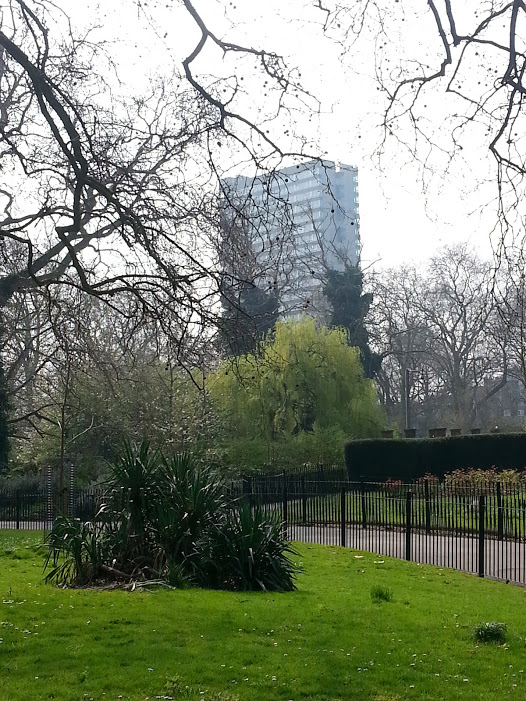
There is quite a lot of wildlife


There is a bandstand from Queen Victoria's Great Exhibition, installed in 1884 and a drinking fountain..
There are two wonderful caryatids holding up nothing in the shrubbery. These come from Rotherhithe Old Town Hall, 1897, which was bombed in World War II. In 1974 these were moved to the Heygate Estate, but now that huge council block has been demolished they are in the park

By 1885 a boating lake had been added, and there are still paddle boats for hire.
Near the lake is the oasis of Ada Salter's Garden. Ada Salter was married to Dr. Alfred Salter. They both worked tirelessly to improve the slums of Bermondsey, fighting disease and trying to improve the borough's housing and living spaces. They planted the thousands of trees we still enjoy and created gren space wherever they could. Ada became the first woman Labour Mayor in 1922, Alfred Salter became a Labour MP and both were Labour councillors. The garden was created in memory of Ada Salter in 1934.
There are two art galleries showing pretty good exhibitions, a nice cafe, a good playground, a running track, lots of space for ball games and running around and a bowls club. The park is used a lot by the locals especially mums with small children.
Across Jamaica Road on the Thames is Kings Stairs Gardens. Edward III built a manor house here in the 14th century and it was used until Tudor times. Later there was a working commercial pottery on the site. The remains of the manor house are still there in the garden. Here is an artist's idea of what the manor looked like.

e-mail: childhoodblog@gmail.com
Thursday, 29 November 2012
Gormley at White Cube
Doing my civic duty I picked up a newspaper from the pavement. It was the Evening Standard, full of interesting stuff including Antony Gormley's new show, Model, at White Cube. My local White Cube in Bermondsey, which would fit in well with my plan to explore Bermondsey Street.
Carrying Southwark Council booklet The Story of Bermondsey, I walked down Jamaica Road, pioneering a new route to Bermondsey Street. Down Tanner Street, in the bit the bus can't penetrate, I found a massive warehouse full of antique furniture, very nice. On to Tower Bridge Road and the squat little church of St. Mary Magdalen with its astonishingly low steeple, hardly a steeple at all. But the church is the oldest building in Bermondsey, built in 1291 right next to Bermondsey Abbey. The Abbey stood roughly between Grange Walk, where there are still remains of the Gatehouse, and Bermondsey Square where the Friday antiquyes market is held. The small building by the church was the parish watch house, where any local malefactors were detained by the night watchmen.

Bermondsey Street runs across Tower Bridge Road here. It is probably the oldest street in Bermondsey, narrow with warehouses on either side and cobbled alleys leading into old yards. It is the place I fell in love with on my very first visit to Bermondsey, walking across Tower Bridge to Zandra Rhodes Museum of Fashion and Textile.

The gleaming modernity of White Cube stands back behind a courtyard. In the Model Room Antony Gormley was talking about his maquets, fascinating essays in translating the human form into cubes and playing around with extending them. Perspex and wire models and drawings show the internal working structures. In the white rooms the nearly black metal models are austere and beautiful; standing, lying, crouching. Finally, stretching the length of one room, lies an interactive cubed form, an exploration of inner and outer space. Enter the tunnel at the toe, adjusting to the dark, and feeling cautiously, a hand out and up to feel the wall and ceiling. Explore the marks on the surface. Crawl through the dark, dark tunnel towards faint light. See the square of light ceiling where the roof opens up, fortuitously incorporating the square light fittings of the gallery. Sitting on a shelf and looking around I saw shades of grey squares superimposed one on another, with one triangle of light. Then there was a very, very dark space, pitch velvet black but with a faint reflective gleam from some far wall. Walking slowly forward, hand outstretched and raised, I suddenly hit a barrier, the reflection was deceptive. This is the head. Then back to where I found a shelf and a space darker than the dark around and crawled to the back. I observed invisibly and sat and listened to the boom, boom of people's feet on the metal, drummed with my hand and someone drummed back.
I wondered when I saw the perspex maquets why Gormley made the final model opaque but now I understood. Transparent would be another story.
whitecube.com/

Carrying Southwark Council booklet The Story of Bermondsey, I walked down Jamaica Road, pioneering a new route to Bermondsey Street. Down Tanner Street, in the bit the bus can't penetrate, I found a massive warehouse full of antique furniture, very nice. On to Tower Bridge Road and the squat little church of St. Mary Magdalen with its astonishingly low steeple, hardly a steeple at all. But the church is the oldest building in Bermondsey, built in 1291 right next to Bermondsey Abbey. The Abbey stood roughly between Grange Walk, where there are still remains of the Gatehouse, and Bermondsey Square where the Friday antiquyes market is held. The small building by the church was the parish watch house, where any local malefactors were detained by the night watchmen.
Bermondsey Street runs across Tower Bridge Road here. It is probably the oldest street in Bermondsey, narrow with warehouses on either side and cobbled alleys leading into old yards. It is the place I fell in love with on my very first visit to Bermondsey, walking across Tower Bridge to Zandra Rhodes Museum of Fashion and Textile.
The gleaming modernity of White Cube stands back behind a courtyard. In the Model Room Antony Gormley was talking about his maquets, fascinating essays in translating the human form into cubes and playing around with extending them. Perspex and wire models and drawings show the internal working structures. In the white rooms the nearly black metal models are austere and beautiful; standing, lying, crouching. Finally, stretching the length of one room, lies an interactive cubed form, an exploration of inner and outer space. Enter the tunnel at the toe, adjusting to the dark, and feeling cautiously, a hand out and up to feel the wall and ceiling. Explore the marks on the surface. Crawl through the dark, dark tunnel towards faint light. See the square of light ceiling where the roof opens up, fortuitously incorporating the square light fittings of the gallery. Sitting on a shelf and looking around I saw shades of grey squares superimposed one on another, with one triangle of light. Then there was a very, very dark space, pitch velvet black but with a faint reflective gleam from some far wall. Walking slowly forward, hand outstretched and raised, I suddenly hit a barrier, the reflection was deceptive. This is the head. Then back to where I found a shelf and a space darker than the dark around and crawled to the back. I observed invisibly and sat and listened to the boom, boom of people's feet on the metal, drummed with my hand and someone drummed back.
I wondered when I saw the perspex maquets why Gormley made the final model opaque but now I understood. Transparent would be another story.
whitecube.com/
Tuesday, 20 November 2012
Eel Pie and Mash
The first time I tried eel was down The Cut, by the Young Vic. I had gone to see Trevor Nunn's
Timon of Athens, so that is a long time ago. I had, I think, jellied eels, in a white-tiled eel pie shop. I went to look for it last week but it is not there now.

My next eel was at Lou Farrow's Snack Bar and Take Away; Traditional Pie and Mash, down the Blue, off Blue Anchor Lane, just past the railway bridge, in Bermondsey. It is a cafe. I went in and asked for eel pie and mash and the man at the counter said something I didn't understand. He said it again, I still didn't understand. He asked again so I said 'yes'. He gave me a pie, some mashed potato a bowl of green liquid with chunks of something interesting in it, and another bowl of more green liquid. The eels were in the first bowl. They were, well, interesting. The green liquid was like a thick green soup. It turned out he was asking me if I wanted extra 'liquor'; the green soup. Till last week I thought it was pea soup but it isn't.

The original shop was established in 1902, there is an internet site, and they say they will deliver throughout the UK, to other pie shops.

After that I walked back to the market at The Blue and found the fishmonger, who was selling jellied eels. They were in salt jelly, which was nice, but the eels were a bit rubbery. I need to experiment further with these. The fishmonger told me that these days the eels don't come from the Thames but all the way from Ireland; Mick's Eels. The lion sculpture in the market was paid for by local shop keepers and may, or may not, be the Milwall Lion.
According to Wikipedia there still about 80 eel pie and mash shops around the east end of London so I still have more investigating to do. One, Goddards, was previously on Deptford High Street and is now behind Greenwich market. Eel Pie Island, far away up the river near Hampton Court, is called that because Londoners from the East End went there on days out and wanted their traditional food.
 | |||
| Lion sculpture in The blue |
Friday, 31 August 2012
Dickens in Southwark
I have a useful booklet called Charles Dickens and Southwark, from Southwark Libraries, so I caught the bus and went looking for Dickens. Seeing Lant Street from the bus I hastily got off; this is where Dickens lived as a boy when his father was imprisoned in the Marshalsea Debtor's prison and he was sent to work in a blacking factory. Why Marshalsea? Because the King's Marshall was overseer of debt collection.
It was an eerie feeling, walking in Dickens' footsteps, down Lant Street and Mint Street, by Union Street, where, I think, the workhouse once was and on to Borough High Street. Today lots of the streets around are called by names from his novels; Quilp St. Copperfield St. and there is a Little Dorrit Park. I walked up Borough High Street to St. George the Martyr Church , built 1734, where Little Dorrit slept in the vestry when she was locked out of the Marshalsea one night. Across the road the very last remaining wall of the Marshalsea runs along the churchyard. Carved paving stones memorialise the unfortunate debtors locked up there. The prison of King's Bench was on the other side of the road; more well-to-do debtors were imprisoned there.
All along Borough High Street there used to be coaching inns where coaches and wagons coming into London unloaded. The George is famous as the very last inn to retain its upper galleries, where in Elizabethan times spectators would sit to watch the players, on a raised stage in the inn yard. At the Russia House I could see Jacobean or older timbers, revealed under later plasterwork, At the Tabard is a memorial to John Harvard, born in Southwark, who sailed to Massachusetts in 1637, founder of Harvard College. The 16th century St.l Christopher's Inn was once on the site of Kentish Buildings, and is remembered in a plaque at the yard entrance. All those old entrances are still there, paved with huge, uneven cobbles that must have been there in Dickens' time too.
It was an eerie feeling, walking in Dickens' footsteps, down Lant Street and Mint Street, by Union Street, where, I think, the workhouse once was and on to Borough High Street. Today lots of the streets around are called by names from his novels; Quilp St. Copperfield St. and there is a Little Dorrit Park. I walked up Borough High Street to St. George the Martyr Church , built 1734, where Little Dorrit slept in the vestry when she was locked out of the Marshalsea one night. Across the road the very last remaining wall of the Marshalsea runs along the churchyard. Carved paving stones memorialise the unfortunate debtors locked up there. The prison of King's Bench was on the other side of the road; more well-to-do debtors were imprisoned there.
All along Borough High Street there used to be coaching inns where coaches and wagons coming into London unloaded. The George is famous as the very last inn to retain its upper galleries, where in Elizabethan times spectators would sit to watch the players, on a raised stage in the inn yard. At the Russia House I could see Jacobean or older timbers, revealed under later plasterwork, At the Tabard is a memorial to John Harvard, born in Southwark, who sailed to Massachusetts in 1637, founder of Harvard College. The 16th century St.l Christopher's Inn was once on the site of Kentish Buildings, and is remembered in a plaque at the yard entrance. All those old entrances are still there, paved with huge, uneven cobbles that must have been there in Dickens' time too.
Subscribe to:
Posts (Atom)