I have been reading a wonderful book by H.V.Morton,
In Search of London, published in 1951. An extraordinary thing about this book, is that it was written while London was still devastated by the Blitz. Morton describes vividly the early history of London, the devastation of the Great Fire in 1666, the opulence of Edwardian London, and the London of the 1930s, just before the second World War. Then he describes walking the City in the Blitz, from Cheapside to St. Mary le Bow, 'a bare and roofless shell', he mourns a special fish restaurant once called Simpson's, visits the Guildhall, where the 'big black timbers of the roof lay criss-crossed and charred, jet-black and wet across shapeless piles of masonry', the Gog Magog statues at the entrance blown to smithereens. All around St. Paul's were acres and acres of ruins; 'the roads high with fallen masonry, the gas mains on fire..' It was still a scene of devastation when he wrote the book.
So I took the 47 bus from Bermondsey over London Bridge, thinking of T.S. Eliot:
'Unreal City,
Under the brown fog of a winter dawn,
A crowd flowed over London Bridge, so many,
I had not thought death had undone so many.
Sighs, short and infrequent, were exhaled,
And each man fixed his eyes before his feet.
Flowed up the hill and down King William Street,
To where Saint Mary Woolnoth kept the hours
With a dead sound on the final stroke of nine.'
(The Waste Land, 1922)
H.V. Morton says that Old London Bridge, the original bridge with the houses all along it, ended at the church of St. Magnus Martyr, and the arcaded tower of the church was part of the original footway.
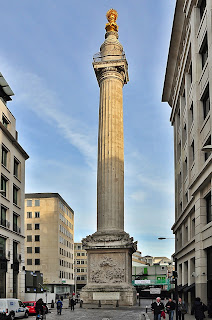 |
| The Monument (Wikipedia) |
I went to look at the Monument to that previous destruction of London, the Great Fire of 1666. Pudding Lane, where the fire started in a baker's shop, is just around the corner.
Morton says the Fire raged for three days. In those days the Square Mile of London within the original Roman Wall was London, a crowded square mile of narrow alleys, houses, shops. The great palaces of the nobility were along Strand, the Court and fledgling Parliament were at St. James's. the All the streets of the West End were fields then. Piccadilly, Trafalgar Square, Mayfair, even Bloomsbury had not been thought of.
After the Great Fire Old St. Paul's, the second largest Christian church in the world after St. Peter's was a roofless ruin. John Evelyn describes it:
'I went this morning on foot from Whitehall as far as London Bridge, through the late Fleet ST, Ludgate Hill by St. Paul's, Cheapside, Exchange, Bishopsgate, Aldersgate and out to Moorfields, thence through Cornhill etc. with extraordinary difficulty, clambering over heaps of yet smouldering rubbish and frequently mistaking where I was: the ground under my feet so hot that it even burnt the soles of my shoes.'
(Quoted in H.V. Morton)
The inscription on the Monument says that 89 churches were burned, with the Guildhall, hospitals, schools, libraries, 13,200 houses, 400 streets, covering 436 acres. There are 345 steps to the top of the Monument, and, like H.V. Morton, I hesitated. There were a lot of school children clustered around the entrance and, unlike H.V. Morton, who went right up, I decided that it could wait for another day.
Seventeen years after the Great Fire 25 of the burned 89 churches had been rebuilt, many, most? by Sir Christopher Wren. I would very much like to know: Why did London need the enormous church of St. Paul's and 89 churches, all clustered so very close together? To say nothing of Westminster Abbey, not so very far away.
Thinking of Shakespeare, I set off for Eastcheap and the Boar's Head.
Wikipedia says there was a Boar's Head Tavern, owned by Sir John Falstof, but it was in Southwark, and another Boar's Head in Whitechapel, where plays were staged. The Eastcheap Boar's Head was demolished in 1831 and the sign is now at Shakespeare's Globe. Shakespeare lodged in various places around the old city; Charles Nicholl's book
The Lodger tells the story of his time in Silver Street around 1603. There was a market on Eastcheap from Saxon times, so that is why it is called Eastcheap.
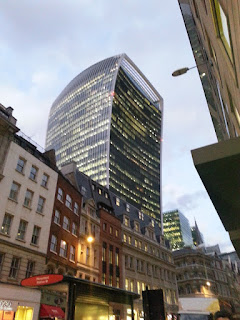 |
| Where the Boar's Head once was |
I found myself in Threadneedle Street outside the Bank of England, so I peeked in to see Sir John Sloane's vaulted ceilings but it was late and the Museum, where you can lift a gold bar, was closing. H.V. Morton says the Walbrook river runs beneath the Bank, and Roman London was built on its banks, when St. Paul was making his missionary journeys. Emperor Claudius, the stammering Emperor so well acted by Derek Jacobi, invaded, with elephants, following a successful action by his legions near a ford called Lyn-din which I suppose was a crossing on the Walbrook river. Claudius stayed in Britain sixteen days and decided a city would be built at Lyn-din. The Romans also built what was for a very long time the only bridge across the river; London Bridge. I had never realised before that Bank tube station is called after the Bank of England.
I went on to explore the Royal Exchange. This is the place where brokers, merchants, and Lloyds insurers met from 1581, to transact their business, but they are long gone to more modern commercial palaces. The present building dates from the 1840s and looks like a Greek or Roman temple. Inside there are now restaurants and boutiques but there is also a frieze by various Victorian artists running all around the walls showing scenes from the history of Britain. There is a huge bronze statue of the Duke of Wellington outside, cast from the cannons captured during the Napoleonic wars.
Then to St. Mary Woolnoth, a beautiful 18th century church by Nicholas Hawkesmoor, but built on the site of much older churches and a possible pagan temple. Prominent anti-slavery campaigners worshipped here, including William Wilberforce and it inspired Peter Ackroyd's Gothic novel
Hawkesmoor. King William Street is not named for William III but for William IV, uncle of Queen Victoria who was king when the street was created.
Wikipedia reminded me that T.S. Eliot, when he wrote
The Waste Land, was working in a local bank.
Finally I stopped at another Wren church, St. Clements Eastcheap, just off King William Street, in Clement's Lane; Eastcheap once extended to this point. St. Clement of Rome was the patron saint of mariners, as well as patron saint of marble-workers and stone-cutters. This is the St. Clements of the nursery rhyme because there was once a market at the end of London Bridge where Spanish ships unloaded and sold their oranges and in those days the smell of oranges was all around.
'Oranges and lemons
Say the bells of St. Clements'
I meant to write the whole story of my visit to the City in one post but there was so much to say that I will have to divide it into at least two posts, maybe more.


